
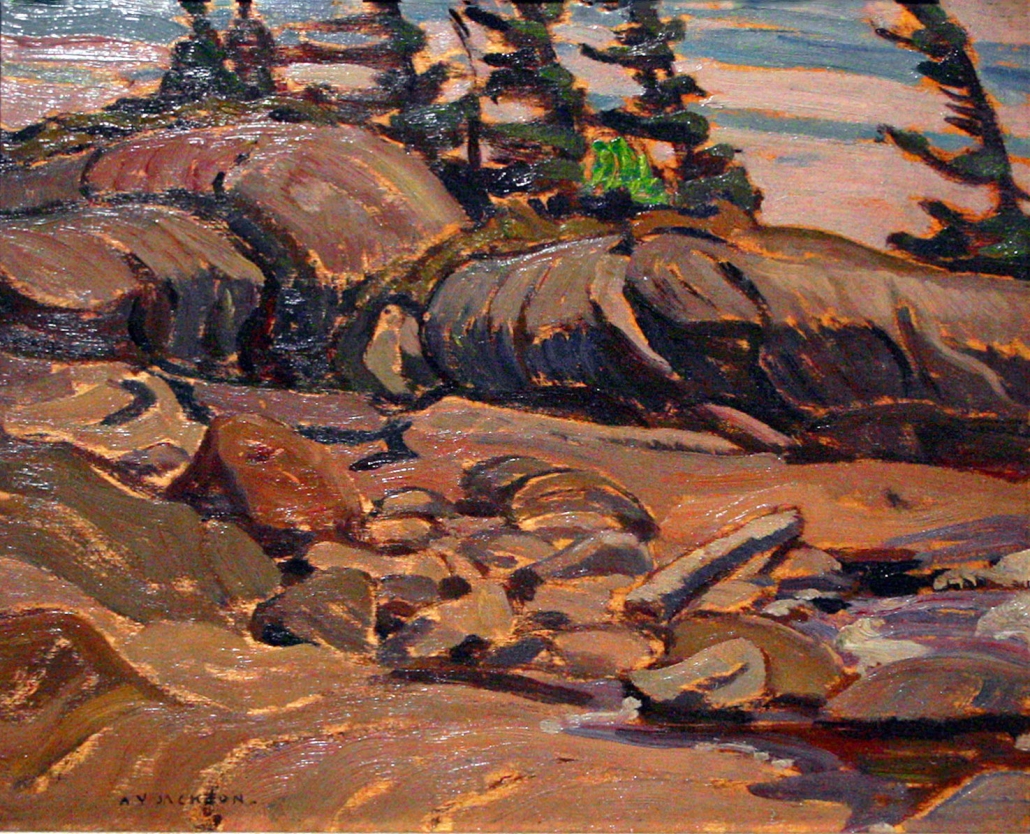
Alexander Young Jackson RCA CGP OSA
(1882 – 1974)
Alexander Jackson was a Canadian painter and one of the founding members of the Group of Seven, making a significant contribution to the development of Canadian art and fostering connections between the artists of Montreal and Toronto.
Born on October 3, 1882, in Montreal, Quebec, Jackson faced early hardship after his father abandoned his family of six children. As a young boy, he worked as an office boy for a lithograph company, where he began his art training. In the evenings, he attended classes at Montreal’s Monument-National.
In 1905, Jackson made his way to Europe on a cattle boat, returning by the same means and continuing on to Chicago. In Chicago, he joined a commercial art firm and studied at the Art Institute of Chicago. He saved his earnings and, by 1907, was able to travel to France to study Impressionism. In Paris, Jackson enrolled at the Académie Julian under the tutelage of J.P. Laurens, where he decided to become a professional painter.
Upon returning to Canada, Jackson settled in Sweetsburg, Quebec, where he painted works such as The Edge of Maple Wood, a Neo-Impressionist piece. Struggling financially and discouraged by the Canadian art scene, he considered moving to the United States. However, a letter from J.E.H. MacDonald changed his course. MacDonald, having seen The Edge of Maple Wood at a Toronto art show, inquired about purchasing the painting on behalf of Toronto artist Lawren Harris.
Jackson’s decision to stay in Canada proved pivotal. He became an important part of the Toronto art community, bringing with him a respected, though not widely recognized, talent honed through his European studies. His time at the Studio Building in Toronto in 1914 marked the beginning of his deeper involvement with the Group of Seven. There, he shared a studio with Tom Thomson for a year, and together they formed a close bond. Jackson and Thomson, both avid outdoorsmen, frequently fished and sketched together, beginning with a trip to Algonquin Park in the fall of 1914.
Inspired by Thomson, Jackson and the other painters who would later be known as the Group of Seven embarked on trips to Algonquin Park, Georgian Bay, Algoma, and the North Shore. These journeys, and their shared passion for landscape painting, helped define the bold and distinctive style that the Group would become known for.
Other Artists that might interest you