Dorothy Henzell Willis
(1899 – 1985)
Dorothy Henzell Willis was born in England in 1899 and emigrated to the United States with her family in 1907, settling in Chicago. A few years later, they moved to Winnipeg, and by 1913, they had relocated to Edmonton, Alberta. At the age of 18, Dorothy married and soon began immersing herself in the local arts scene. She became an active participant in the art communities of both Alberta and British Columbia, holding various positions, including president of the Edmonton Art Club and secretary of the Alberta Society of Artists. She also joined the Women Sketch Hunters of Alberta and the Vancouver Art Gallery Association.
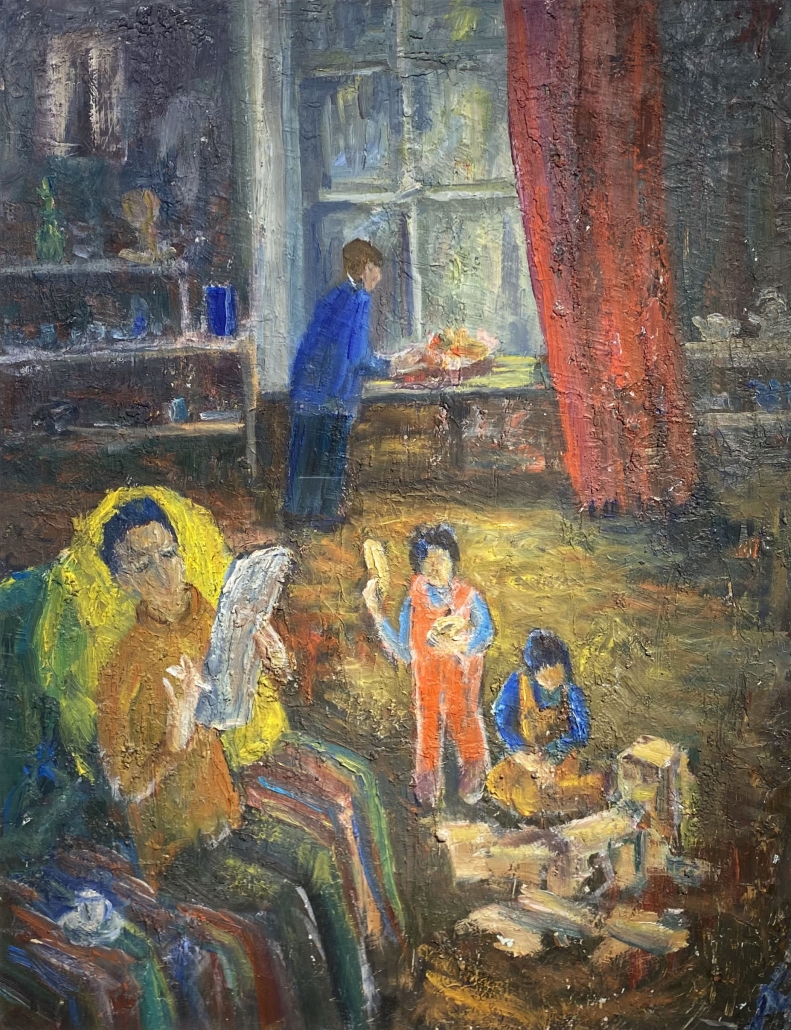
Dorothy’s early education in art began under the guidance of J. Gordon Sinclair at Edmonton Technical High School, and she continued her studies during summer sessions with A.C. Leighton. While records of her other educational pursuits and exhibitions remain sparse, her artistic growth was evident in her work. Art historian Mary-Beth Laviolette notes that Dorothy, like many of her peers in Alberta during the 1920s to 1940s, adhered to a traditional academic style that reflected British painting traditions. However, as Dorothy’s artistic journey evolved, so did her work. After her divorce in 1946, she departed from Edmonton, and her artistic style underwent a significant transformation. She shifted from the gentler academic approach to a more emotionally expressive and psychological exploration of the human experience, drawing from her personal life, as well as the lives of her friends and family.
For three years, Dorothy served as an artist-in-residence at the University of British Columbia, where she lived in a trailer on campus. Her strong desire to experience the world led her to Paris in 1949, where she formed a close friendship with fellow Canadian artist Joseph Plaskett. Dorothy spent the next 25 years traveling and living in Europe, including stints in England, France, Wales, and Denmark, as well as traveling throughout Europe and North Africa. Despite living modestly, her commitment to her art remained unwavering. She painted with vigor, utilizing bold colors and expressionistic techniques to imbue her works with deep emotion and energy. While she primarily worked in oil paints, Dorothy also experimented with watercolors, drawing, and printmaking, including woodcuts, linocuts, and monoprints.
In 1975, Dorothy returned to Canada and settled in Victoria, British Columbia, with her son, Robert, and his wife, Verna. After her return, only one documented painting—featuring a double-sided composition—was created. Dorothy passed away in 1985 in Victoria, leaving behind a lasting legacy of modernist works. Her contributions to Canadian art, particularly modernism, remain significant and enduring.
Her work has been exhibited in numerous exhibits in Canada including
- the Art Gallery of Alberta Vancouver Art Gallery
- Glenbow Museum
- Montreal Art Association
- Manitoba Society of Arts
- Canadian Society of painters in Watercolour
- National Gallery of Canada – Travelling Exhibition
and the Riverside Museum, N.Y.
Other Artists that might interest you