
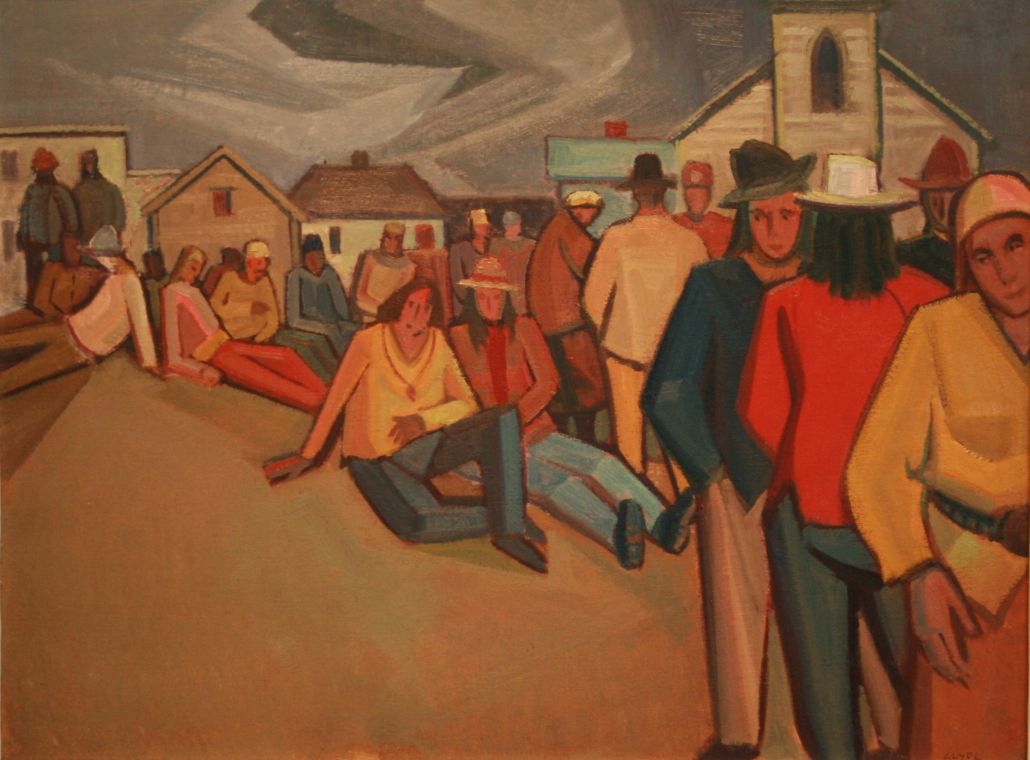
Henry George Glyde
(1906 – 1998)
Henry George Glyde, an English-born Canadian painter, draftsman, and art educator, was born in Luton, England. He studied at the Royal College of Art in London, where he also served as a student instructor from 1929 to 1930. Later, he taught at various schools before moving to Canada in 1935 to teach drawing at the Provincial Institute of Technology and Art in Calgary. By 1936, he had become the head of the art department and began exploring the western Canadian landscape as a primary subject for his paintings.
Glyde was appointed head of the painting division at the Banff School of Fine Arts, where he worked from 1937 to 1966. During this time, he met A.Y. Jackson, and in 1943, the two artists traveled north on a commission from the National Gallery to create studies of the Alaska Highway. Glyde also contributed to the development of art education in Alberta, founding the Department of Fine Art at the University of Alberta, where he taught from 1946 to 1966.
As a master draftsman, Glyde was known for his oils and murals, which often exhibited social realism. His murals carried a classical mood and structure, especially in his interpretations of the Alberta landscape and the British Columbia coast. One of his notable works, Imperial Wildcat No. 3, Excelsior Field, near Edmonton, was featured on a $1 stamp issued by Canada in 1967 to celebrate the country’s Centennial.
In 1987, the Glenbow Museum organized a major retrospective of his work, cementing his legacy in Canadian art history.
He was a member of :
- the Canadian Society of Graphic Art
- the Alberta Society of Artists (president in 1945)
- the Federation of Canadian Artists,
- and was made a full member of the Royal Canadian Academy of Arts in 1949.
He died on March 31, 1998, in Victoria, British Columbia, Canada.
Other Artists that might interest you