
llingworth Kerr
RCA BCSA FCA RCA Canadian (1905-1989)
Born and raised in Lumsden, Saskatchewan, Illingworth Kerr began drawing at an early age. His mother, a watercolorist, taught him what she knew and nurtured his artistic ambitions. In 1919, Kerr gained early recognition when a number of his works won 13 first prize awards at the Regina Exhibition.
In 1923, Kerr moved to Toronto to pursue formal art education at the Ontario College of Art. He studied under prominent instructors including Arthur Lismer, J.E.H. MacDonald, Frederick Varley, and William Beatty. While the Group of Seven approach to painting was not formally taught, Kerr was influenced by their ideals through exhibitions and studio visits.
During the Great Depression, Kerr struggled with few sales despite having a number of exhibitions. In 1936, feeling defeated and isolated, he burned most of his paintings from this period and left for England, embarking on ten years of nomadic work in film, art, and writing. Reflecting on this time, Kerr remarked, “My ardent nationalism went down the drain; yet I never quite relinquished the dream of painting the prairie as I felt it should be done.”
In 1946, Kerr returned to teaching at the Vancouver School of Art, and the following year, he moved to Calgary to head the Art Department at the Provincial Institute of Technology and Art (now ACAD and SAIT). Over the next 20 years, Kerr laid the foundation for the Alberta College of Art and became an influential instructor and mentor.
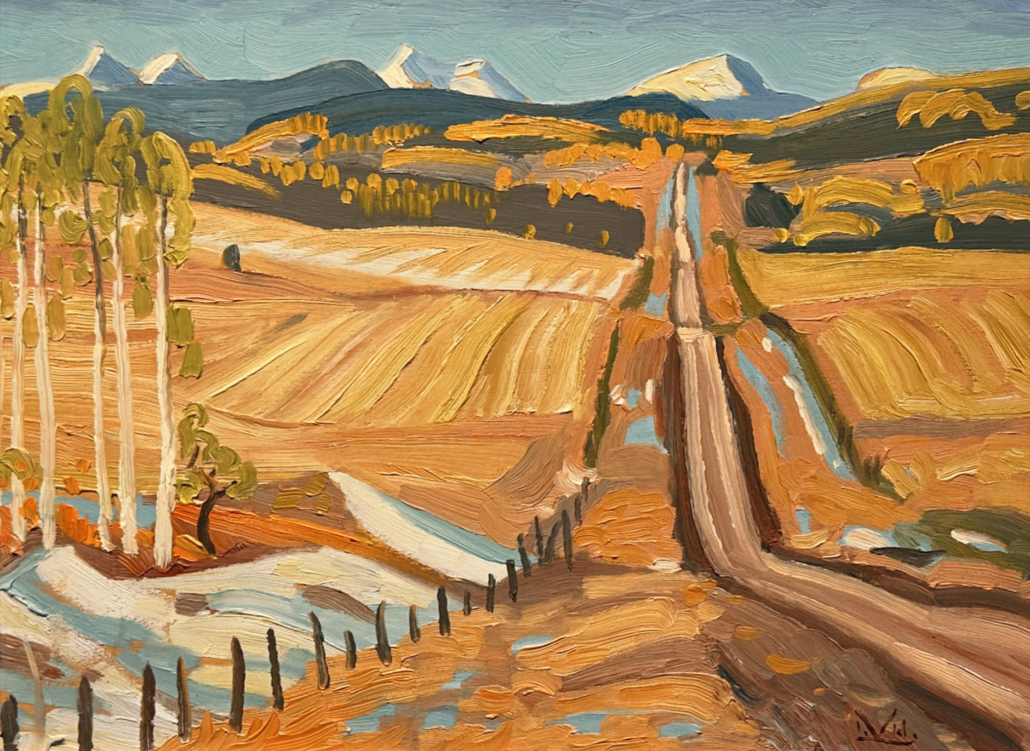
Kerr was unable to paint full time until his retirement in 1967. Surrounded by the mountains, foothills, and prairie landscapes, he found his artistic inspiration in the vast, powerful spaces of the West, seeking to capture their mood rather than tangible forms.
In 1973, Kerr received an honorary doctorate from the University of Calgary. In 1975, a major retrospective of his work was held at the Alberta College of Art’s gallery, later renamed the Illingworth Kerr Gallery, and toured Regina and Saskatoon. In 1983, Kerr was named to the Order of Canada. The following year, his work was celebrated in a major retrospective titled Harvest of the Spirit, which toured nine Canadian cities.
As Maxwell Bates once said, “Few painters have been closer to the Prairies than Illingworth Kerr. He has made some of the most successful interpretations of Prairie landscape ever achieved – translating the Prairie into contemporary idioms.”
Other Artists that might interest you