Marcel Barbeau
(1925 – 2016)
Marcel Barbeau, a renowned Canadian artist, was a painter, sculptor, graphic artist, and performer who continuously pushed the boundaries of abstraction. His work explored a variety of artistic techniques and utilized emerging technologies to convey his unique creative vision.
Born in Montreal, Barbeau began his formal education in art at l’École du Meuble, where he studied under the guidance of Paul-Émile Borduas. During his time at the school, he developed a close partnership with Jean-Paul Riopelle, with whom he later shared a studio. It was at the École where Barbeau connected with other students of Borduas, and together they formed the group that would later be known as the Automatistes. Influenced by psychoanalysis and the use of the unconscious, Barbeau’s work from 1946 to 1957 was deeply shaped by these themes.
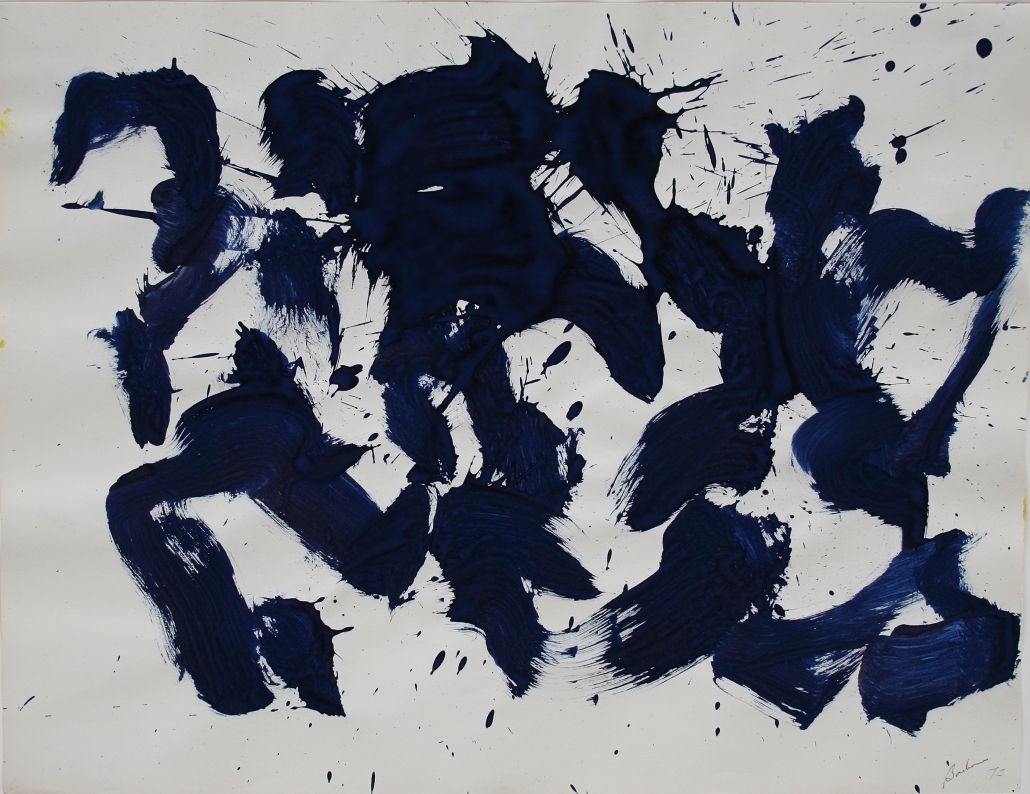
Following the departure of Riopelle to Paris and Borduas to New York, Barbeau began to explore his personal approach to abstraction. In 1952, he presented small ink non-objective paintings in New York City, also showcasing his works in Montreal, Ottawa, and Quebec City. By 1957, Barbeau returned to drawing from live models and began experimenting with calligraphy. His exploration of drawing and collage continued to dominate his work until 1961.
As an artist who worked across various media, Barbeau’s contributions spanned many aspects of visual art. He transcended the traditional boundaries between disciplines, merging his collages into paintings, sculptures, and prints, while his poetic drawings often incorporated relief elements drawn from his painterly techniques.
A curious and open-minded artist, Barbeau immersed himself in contemporary artistic movements from various disciplines. His fascination with poetry, music, dance, and architecture influenced his own creative practices. He would often incorporate structural elements from these art forms, using them to inform his visual language and confirm his aesthetic impulses.
In a 2010 interview, Barbeau reflected on his artistic process, saying: “When I paint I never look for an emotion. But the forms in the painting will get together and nearly make love; the forms want to live together.”
Barbeau’s work remains an example of innovation, constantly evolving through the exploration of new mediums and ideas.
PUBLIC COLLECTIONS
Barbeau is represented in well over fifty public and corporate collections including:
- the National Gallery of Canada;
- the Art Gallery of Ontario;
- and the Stedelijk Museum, Amsterdam.
HONOURS
- 1972 Canada Council’s Victor Martyn Lynch-Staunton Award
- 1995 Officer of the Order of Canada
- 1998 Barbeau`s work is used as a stamp by Canada Post as a part of the collection on the Automatistes
- 2003 member, Royal Canadian Academy of Arts
- 2013 Governor General’s Awards in Visual and Media Arts
- 2013 Paul-Émile Borduas Award, prix du Québec
- 2015 Ordre National of Québec
Other Artists that might interest you