
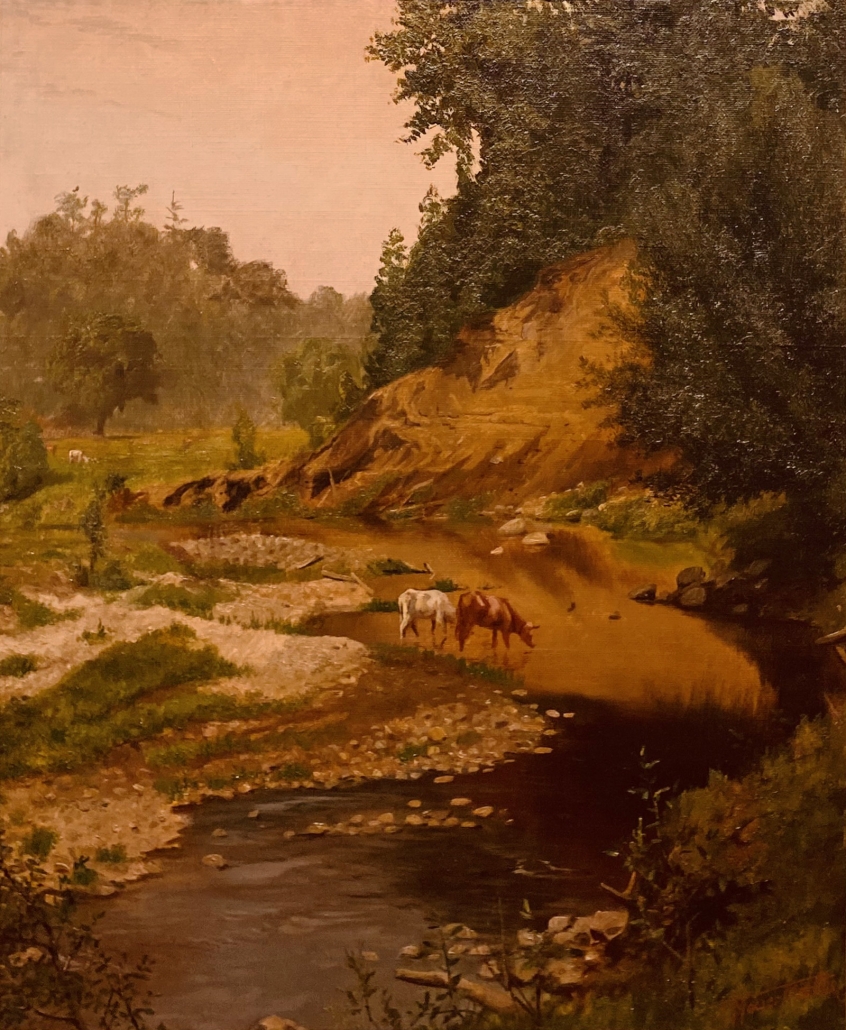
Thomas Mower Martin – (1838 – 1934) RCA
(1838 – 1934)
Thomas Mower Martin (1838–1934), an English-born Canadian landscape painter, is often referred to as “the father of Canadian art.” Born in London, England, Martin found life there unappealing and sought a healthier lifestyle in Canada. In 1862, he emigrated to British North America with his wife, Emma Nichols, and their growing family. Taking advantage of the Canadian government’s offer of free land, they settled in Muskoka, Ontario. However, due to the poor quality of the land for farming, they eventually moved to Toronto, where Martin established himself as a professional painter.
Martin became well-known for his landscapes, still lifes, animals, and portraits, working in oils, watercolors, and etchings. He was a key member of the “Railway Painters,” a group of artists who were granted passes by the Canadian Pacific Railway to travel and paint landscapes in western Canada. Earlier in his career, Martin had traveled and painted landscapes across eastern Canada and the United States and also provided illustrations for two books by A & C Black: Canada and Kew Gardens.
A significant figure in the establishment of Canadian art institutions, Martin was a founding member of the Ontario Society of Artists in 1872 and a founding director of the Ontario School of Art (now OCAD University). He was also a charter member of the Royal Canadian Academy of Arts in 1880 and a member of the Royal British Colonial Society of Artists (1909).
Throughout his life, Martin exhibited widely, and his works are held in numerous public and private collections, including Windsor Castle in England. A member of the Swedenborgian church, Martin wrote philosophical leaflets for the organization. He passed away at the age of 96 in 1934.
Other Artists that might interest you